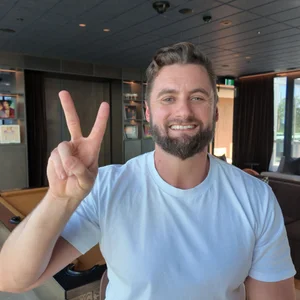
Stop Chasing, Start Embodying: A Breathwork Coach on Building an Identity That Lasts
Aiden Domic on why "faking it till you make it" is broken, and what to do instead.
Watch On YouTube
〰️
Watch On YouTube 〰️

TL;DR
Most people are chasing an outcome when they should be becoming a person; that's the difference between doing and embodying.
You're not faking it till you make it. You're making yourself the person who can do the thing.
Six breaths a minute, in through the nose, out through pursed lips, is the simplest nervous system tool you own.
Processing emotions is a skill. Skip it, and you hurt people. Get stuck in it, and you never move.
If you don't back yourself, no one else will, even the people who love you.
🎧 Available on Spotify, Apple Podcasts, YouTube or wherever you listen to your podcasts.
Introduction
Aiden Domic asked one question in this episode that reframes almost everything: are you a signal, or are you an amplifier?
The signal is the one out front doing the work. The amplifier is the one who takes what's already there and lifts it higher. Aiden spent most of his life assuming he was meant to be the signal. Turns out he's the amplifier, and the second he accepted that, everything he'd been forcing suddenly made sense.
Aiden is a Melbourne-based performance coach, breathwork instructor and mindfulness practitioner. He teaches breathwork at Pando Society in Elwood, runs corporate wellbeing programs through Connected Minds, and is building 1 Million Minds, a mission to fill stadiums around the world for mental health. Along the way, he's coached athletes, executives and one client back from a wind-turbine fall to running an ultra-marathon on crutches.
This episode is a practical guide to a bigger question: how do you stop chasing a version of yourself you're supposed to be, and start becoming the one you actually are? If you've ever felt like you're pushing hard without moving, this is for you.
Listen On Apple Podcast
〰️
Listen On Apple Podcast 〰️
Listen On Spotify
〰️
Listen On Spotify 〰️
Stop chasing, start embodying: the real difference between doing and being
What it is: Embodiment is the difference between thinking about being someone and actually being them. It's not a mindset trick. It's a decision to stop performing the version of you that you think will get the outcome, and start becoming the person who naturally produces it.
Why it matters: Most people burn out because the drive is coming from outside them: the result, the recognition, the version of themselves everyone else can see. When the outcome doesn't land, the whole scaffolding collapses. Embodiment moves the fuel source inside, which is why it lasts.
How to apply it:
Notice when you're "trying to be" someone. That trying is the giveaway.
Ask what that version of you would actually do differently, not think, do.
Do one of those things today, before you feel ready.
Common mistake: Treating embodiment as a mindset exercise. It's not. It's a series of small decisions that add up to a different self-image.
Try this today: Name one behaviour the future version of you does daily. Do it once today, without waiting to feel like that person first.
Are you a signal or an amplifier? Why knowing which one changes everything
What it is: Aiden's frame for personality and contribution. The signal creates the primary work or product. The amplifier lifts other people's work and multiplies it. Neither is better, but forcing yourself to be the wrong one drains you.
Why it matters: As Aiden put it: "I've always thought I'd need to be a signal, but I'm actually an amplifier. And that makes sense with who I am, because my whole life I've been trying to just be that signal, when really, I've always been bringing people up."
If you're an amplifier trying to be a signal, no amount of hard work will feel right. Once you accept your role, your energy stops leaking.
How to apply it:
Look at where you naturally add the most value, is it creating, or lifting?
Notice which work leaves you energised versus depleted.
Design your week around your actual role, not the one you think you should have.
Common mistake: Assuming being an amplifier is a lesser role. Aiden's building a global mental health movement as an amplifier.
Try this today: Ask yourself honestly, signal or amplifier? Sit with the answer for five minutes before you dismiss it.
You're not faking it till you make it, you're becoming that person
What it is: The most quoted piece of advice in personal development is, according to Aiden, wrong. You're not pretending to be something you're not. You're rehearsing yourself into someone who genuinely is that thing.
Why it matters: "Fake it till you make it" implies dishonesty. That framing makes people feel like frauds and eventually pull back. Aiden's reframe "you're making yourself that person to be able to put yourself in the position to do it", turns the same action into practice rather than performance.
How to apply it:
Stop calling it faking. Call it rehearsing.
Pick one situation where you feel like an imposter, and identify what the "real" version of you would do there.
Do that thing. Log it. Repeat.
Common mistake: Waiting to feel confident before you act. Confidence is a byproduct of the reps, not a prerequisite.
Try this today: Write down one identity statement "I am someone who…" And take one action that proves it, before the end of the day.
Six breaths a minute: the simplest nervous system tool you own
What it is: A baseline breath practice. In through the nose, out through pursed lips for a count of six. Aiden's target: around six breaths per minute at a healthy resting state. Most people breathe more than double that, and through the mouth.
Why it matters: "The calmest state that you can possibly get to where you're regulating your nervous system is by breathing slower," Aiden explains. Slow the exhale and you shift out of fight-or-flight. Do it consistently and it becomes your default state, not just something you do in a session.
How to apply it:
Breathe in through the nose.
Breathe out through pursed lips for a count of six. The longer the exhale, the calmer you'll feel.
Aim for around six breaths per minute.
Practise ten minutes a day. Then let it show up in your life without thinking about it.
Pro tip: Aiden compares breath practice to lifting weights. You don't feel stronger every session, but when you go to carry the groceries or pick something heavy up, the strength is there. Same with breath.
Try this today: Set a timer for two minutes. Nose in, pursed lips out for six. Notice how you feel at the end.
Process your emotions, don't skip them and don't get stuck in them
What it is: Between feeling something and reacting to it, there's a processing stage. Most people fail at one of two ends. Some skip it and jump straight into action. Others get stuck in the processing and never act.
Why it matters: As Aiden puts it: "If you skip it, like you don't know what you can do… you're probably going to hurt yourself, and you're probably going to hurt other people." Both extremes look different but produce the same problem: you're not actually working with what you feel, you're bypassing it or drowning in it.
How to apply it:
When something lands hard, pause before you act, even 30 seconds counts.
Name what you're feeling and why. That's self-awareness in real time.
Then take action from the logical mind, not the reactive one.
Common mistake: Confusing "processing" with rumination. Processing has an exit. Rumination doesn't.
Try this today: Next time you feel a spike, don't reply, don't act. Breathe six-count for one minute, then decide.
Back yourself before anyone else can
What it is: The willingness to keep going on your vision when nobody around you has caught up to it yet. Aiden's answer to "what would you tell someone starting out?" was blunt: back yourself, because if you don't, no one will.
Why it matters: "They might say they are, but they're not, and they may believe in you. But when something goes wrong, they don't want to see you go through pain. You need to believe in you more than anything." Even the people who love you will flinch before you do, not because they don't believe in you, but because they don't want to watch you hurt. That's why the belief has to come from inside.
How to apply it:
Get clear enough on your vision that opinions can't shake it.
Take opinions on board, but don't outsource your decisions to them.
Keep going through the season where nothing looks like it's working. That's the season that matters.
Common mistake: Mistaking love from others for belief in you. Love wants you safe. Belief wants you to keep going.
Try this today: Write one line about where you're going. Read it before you check your phone tomorrow morning.
Show up with love, even when you're tough
What it is: Aiden's answer to the question Jack asks every guest; the one daily thing everyone should do wasn't a habit or a protocol. It was: love more. Show up in life with an open heart.
Why it matters: "We can be as tough as we want… but at the same time, can you love? Because if you can't, you've got no substance. You're actually just a walking thing of meat at the end of the day." Toughness without love is hollow. It might get you through the day, but it won't build anything that lasts.
How to apply it:
Look at one ordinary thing today; a tree, a door, a person, and put real feeling behind seeing it with love.
Notice what happens in your body. Aiden reckons you'll start smiling.
Bring that same posture into conversations you'd usually approach guarded.
Try this today: Say "I love that" out loud or internally, with feeling, about three things you encounter before lunch.
A story worth staying for: from wind-turbine fall to running an ultra
One of the moments in this episode that grounds every other lesson is Aiden's story about Mick Marshall — the dad of a childhood friend who fell off a wind turbine and was told he'd never walk again.
Mick decided otherwise. He hired a pain specialist, a nutritionist and Aiden as his breathwork and NLP coach. Between them, they built a protocol. Mick walked again. Then he ran the Melbourne Marathon on crutches, breaking a world record. Then they did a 60km ultra together at Mount Buffalo. Then Mick went to Switzerland to do more.
"You've had all these people like your mother, good example, like doing what people said you can't do, just went and did it," Jack reflected. That's what embodiment looks like in practice. Not a mindset trick. A decision, repeated until it becomes who you are.
Quick wins checklist (do these in the next 24 hours)
Practise six breaths a minute for two minutes: nose in, pursed lips out for six.
Ask yourself honestly, signal or amplifier?
Write one identity statement: "I am someone who…" and take one action that proves it.
Next time you feel a spike, pause and breathe before you react.
Look at one ordinary thing today and see it with love. See what happens.
Closing insight
The through-line of this conversation is quieter than the individual lessons: stop trying to be someone, and start being someone. That's the whole shift. Embodiment isn't a mindset trick you do once; it's a series of small decisions that compound into a different self-image over time. The breath work makes it possible. The self-awareness makes it honest. Backing yourself makes it durable. And loving more makes it worth doing at all. The version of you that lasts isn't the one chasing hardest. It's the one that already knows who they are, and shows up as that person before the world catches up.
🎧 Available on Spotify, Apple Podcasts, YouTube or wherever you listen to your podcasts.
Watch me on YouTube
Listen to the True From Podcast
Apple Podcasts - https://podcasts.apple.com/au/podcast/the-true-form-podcast/id1593804496
Spotify - https://open.spotify.com/show/6RVH2O6MbLOCohBKPhXO0L?si=ZI8D3MnhSfSjnohSXYN_MQ
Everywhere els - https://trueform.buzzsprout.com
Sponsor: If you’re interested in trying red and near-infrared light therapy for recovery, pain, and overall health, check out Lumaflex. Use code TRUEFORM for 10% off: https://lumaflex.com.au/TRUEFORM