
The Long Game: Strength, Purpose & Longevity with Jon Sabes

The Long Game: Jon Sabes on Longevity, Blue Zones and Not Growing Old Broke or Alone
Jon Sabes returns to talk about why time feels faster as we age, his advice to cut back on alcohol, how to design your own blue zone, and planning for decades more life.
Jon Sabes on building a life your 80-year-old self will thank you for
TL;DR
- Time feels like it speeds up as we age, which is a good reason to be intentional about how you spend it now.
- Jon's biggest health message: cut back on alcohol. Have one or two, then call it a day.
- Design your environment so the healthy choice is the easy one, starting with your pantry and your friendships.
- At 65, you may have decades of life left. Plan your health, money and relationships for that long game.
Introduction
Jon Sabes is an entrepreneur and the author of Healthy, Wealthy, Longevity. He's the founder of Longevity Financial Partners and has spent years working at the intersection of ageing, health and money. This was his second time on the podcast. In our first conversation, we went through the lessons in his book. This time, we talked about what's changed since then and what he's working on next.
Jon is writing a second book with the working title The Longevity Crisis. It's about what happens when millions of people live longer than the systems built to support them. We also talked about why time feels faster as we age, alcohol, blue zones, friendships and purpose.
A quick note: this is general information, not medical or financial advice. Talk to a qualified professional about your own situation.
Lesson 1: Time speeds up, so be intentional
Insight: Jon once asked his dad why life seemed to keep getting faster. His dad told him life's like a roll of toilet paper: the closer you get to the end, the faster it goes. I had heard almost the same thing from a friend of mine in his 80s, who keeps telling me to enjoy it, take it in and write it down.
Jon looked into it and found that it's a commonly reported experience. He pointed to research suggesting that, as we age, our brains take in and process fewer images per second, so clock time seems to move faster. The paradox, as Jon put it, is that time is accelerating, yet you still need to find ways to stay calm.
Action: Write down one moment from today that you want to remember. Make it a habit.
Outcome: You capture more of your life rather than letting the years blur together.
Lesson 2: Plan for decades more life, not a few years
Insight: Jon's big concern is what he calls the longevity crisis. People are living much longer, and in the US that's colliding with a huge wave of retiring baby boomers and a retirement system that wasn't designed for them. His point is that 65 isn't the start of a short final chapter. You might have two to four decades ahead of you, and if you've looked after your body, 85 could feel just as good as 65.
He also talked about "n of one". In large groups, actuaries can predict how many people will live to a certain age. They just can't tell you which person. Because none of us knows whether our savings need to last 10 years or 40, Jon believes we need both personal responsibility and a strong collective safety net.
He was fascinated by Australia's super system, which doesn't exist in the US. He described a study he'd read about Australian retirees, many of whom died with roughly the same amount in their accounts as when they retired. He sees that as a sign of how afraid people are of outliving their money. I've been going to talks at the University of Melbourne on retirement, AI and longevity, and many of the same themes are coming up here.
Action: Picture yourself at 85. Write down what you want to be able to do physically, who you want around you and what you'll need financially to make that possible.
Outcome: Your long-term goals become concrete enough to plan for.
Lesson 3: Don't grow old broke and alone
Insight: Jon's way of summing it up stuck with me: there are two things you need to avoid as you age, being broke and being alone. You might cope with one, but having both is the worst-case scenario. His first book is about your role in reducing the odds of that happening.
He also thinks retirement at 65 is something of a fiction. There's nothing magical about the age. Instead, he encourages people to think about a much longer arc of work, purpose and contribution. He's 59, and he's excited about how AI, self-driving cars and precision health could keep people productive and mobile well into their 80s.
That fits with something I see a lot. Younger people often aren't focused on retiring. They want to find work they're passionate about and keep going. AI will also change many jobs, which is harder for people who've tied their identity to what they do for money. Jon is optimistic. As he put it, the buggy whip makers figured out what to do when the car came along.
Action: Ask yourself where you'd stand on each of these if you retired today: health, money and people. Pick the weakest and take one step on it this week.
Outcome: You start reducing your biggest risk instead of hoping it sorts itself out.
Lesson 4: Cut back on the alcohol
Insight: When I asked Jon what he's doing at 59 so his 80-year-old self feels healthy, his answer was simple. He does strength training, keeps up his cardio, uses the sauna with hot and cold, gets outside in the sunlight and fresh air and eats clean. Then he made a plea: stop drinking so much alcohol.
He's watched friends deal with serious problems lately, and he says that by 60, this is when the damage starts to show. His advice isn't necessarily to go sober. Have one or two beers, but there's no reason to get blotto. Jon cut back himself after alcohol started triggering an allergic, autoimmune-type reaction, and he found he simply stopped wanting to drink much.
I see the same thing with my clients. In Australia, alcohol is part of every celebration, catch-up and bad day. People will change everything else first, but if they cut back on alcohol first, they'd feel better and see faster results.
When you want to escape, Jon suggests going for a walk outside instead. Take the dog, go somewhere with other people, get a coffee and give someone a compliment. Fresh air, a little sunlight and a positive interaction can put enough space between you and whatever triggered you to reset your mindset.
Action: Set a two-drink limit for your next social event, and plan a walk for the next time you feel like reaching for a drink to cope.
Outcome: Your older self gets the benefit, and your results now improve too.
Lesson 5: Blue zone your home
Insight: For Jon, the big takeaway from the blue zones research is that environment shapes behaviour. People in those communities didn't rely on discipline alone. Their surroundings nudged them towards better choices. You can do the same thing.
Start small. If your pantry is full of sweets and salty snacks, you'll eat them. If it's stocked with nuts, dates and Greek yoghurt, you'll eat those instead. Put your running shoes by the door. When you have the choice, pick the apartment near running trails or the one with sunlight, not the dark one. As Jon pointed out, you can't always choose where you live because of kids or work, but you can often choose the building.
Decluttering counts too. I keep my own space minimal, because I find a cluttered environment makes it hard to think. Jon finds cleaning out a closet or a shelf incredibly rewarding, and the decluttered space feeds into everything else.
Action: Do a pantry swap this weekend. Remove the foods you overeat and stock the ones you want to default to.
Outcome: Healthy eating takes less willpower because the easy option is already the better one.
Lesson 6: Your friends are part of your environment
Insight: Jon considered himself a lone wolf for a long time, and he thinks that's common for men. The blue zones research changed his mind. He's been intentionally working on his friendships for years, and it's made a difference.
If you're stuck in the routine of work, TV and sleep, his advice is to start by thinking about the people who depend on you and love you. If you don't have those people, go and find them. Look for groups that like getting outside and doing activities. If your mates mostly want to get drunk, you're stacking the odds against yourself.
To reconnect, he suggests working in concentric circles. Start with the people you take for granted the most, usually your partner and kids. Then move out to friends. Scroll through your phone, find someone you haven't spoken to in a while and invite them for a run. Jon credits meeting his wife at college with pulling him away from the bad-boy behaviour with his mates. He loves them, but as he put it, they were going to self-destruct.
Action: Message one friend you've lost touch with this week and suggest doing something active together.
Outcome: You strengthen the connections that protect your health as you age.
Lesson 7: Purpose can be small, and it compounds
Insight: Jon's big four are eat wisely, move more, connect with others and have purpose. On purpose, he says you don't need to save the world. Cleaning the house and doing a proper grocery shop can be enough purpose for one day. Small wins create a positive loop that radiates out.
He values early mornings, the quietest part of the day, as long as he doesn't start scrolling on his phone. Balance, he admits, is tough. He just takes stock. If he hasn't exercised, he needs to get outside and run some hills. When I'm busy, I follow a yoga video on YouTube at home. Sometimes good enough is good enough, and Jon's advice was not to be so hard on yourself.
We finished on compounding. My biggest challenge as a PT is that people can't see results in real time. Jon compared health to putting a dollar away each week. At first, the changes are barely noticeable. Then one day you wake up and it's grown into something big.
Action: Choose one small habit you'll repeat every day for the next 30 days, whether that's a walk, a vegetable with every meal or 10 minutes of stretching.
Outcome: You start building the kind of compound interest that pays off for your health.
Quick wins
- Stock your pantry with the snacks you want to eat.
- Put your shoes by the door tonight.
- Limit yourself to two drinks at your next catch-up.
- Message one old friend about a walk or a run.
- Declutter one shelf or drawer today.
Closing insight
Jon's message is about playing the long game. Longevity can be one of humanity's greatest achievements, giving us 10, 20, 30 or 40 extra years of health. But we need to plan for it, individually and as a community. Look after your body, build your savings, keep your friendships strong and find purpose in small things. If we each do our part, Jon believes it adds up to a society where longevity becomes a dividend for our kids rather than a burden on them.
Connect with Jon
Visit Jon Sabes, find out more about Longevity Financial Partners, or follow Jon on Instagram and YouTube.
Listen to the full episode
The full conversation is on Spotify, Apple Podcasts and YouTube, or press play at the top of this page.
Related episodes: Healthy, Wealthy and Living Longer with Jon Sabes and Healthy, Rich and Happy with Jacopo Iasiello
Show notes
In this episode, Jon Sabes returns to explore what it really means to play the long game in life. Longevity doesn’t happen by accident; it’s something you build through small, intentional habits practised consistently over time.
We talk about strength training, purpose, community, and why the older version of you is shaped by the routines you live today. We also explore why time feels like it accelerates as we age, what it means to create an environment that supports health, and how to maintain your vitality later in life.
This is a conversation about living well now so that your future self can live well later.
In this episode:
• The perception of time and aging
• Strength and muscle as the foundation of longevity
• Why purpose keeps people alive
• Alcohol and its long-term impact on the body and mind
• Lifestyle architecture: how your environment shapes your habits
• The importance of friendship and community as you grow older
Watch or listen to learn how to build a life you’ll still love at 80.
Connect with Jon:
Instagram: @jonsabes
LinkedIn: Jon Sabes
TikTok: @jon.sabes
YouTube: @jonsabes
Personal Website: www.jonsabes.com
Business Website: www.longevityfp.com
Philanthropy Website: www.sabes.foundation
Contact
Email: jsabes@longevityfp.com
Cell: (612) 388-2223
Resident: Austin, Texas
🎧 Available on Spotify, Apple Podcasts, YouTube or wherever you listen to your podcasts.
Watch me on YouTube
https://youtu.be/v5USOzky7SQ
More like this

What Every Woman Over 35 Needs to Know About Her Body With Emily Spurling
Women over 35: if you're eating less, training harder, and getting nowhere, the problem isn't your willpower; it's your physiology. In this episode of The True Form Podcast, women's health coach Emily Spurling breaks down exactly what changes in a woman's body after 35, why corti

Allie Chandler: Healing Chronic Lyme, Rewiring the Nervous System & Empathy-Led Marketing
Allie Chandler spent nearly 8 years bedbound with chronic Lyme disease, mould toxicity, and hyperadrenergic POTS; a condition where her heart rate spiked from 55 to 180 every time she stood up. Dozens of doctors. Endless protocols. No answers. In this episode, Allie shares exactl
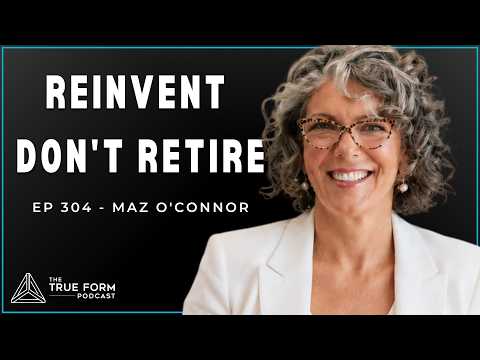
Maz O'Connor: Reinvent, Don't Retire. Why Your Best Years Are Still Ahead
It's never too late to start. At 55, Maz O'Connor had built the life she'd manifested 15 years earlier: a beautiful home in coastal Victoria, her own yoga and event space, a thriving community. By every external measure, she'd made it. Then a voice she couldn't ignore said: there